I know what it’s like to feel the pressure of time, with stress mounting while the day rushes ahead. There were days in my life when every hour felt like a race. As I searched for practical ways to find calm and presence, I discovered the unique strengths of Marquesan meditation—a cornerstone of the Marquesan Metatheory of Consciousness, which guides much of the work and ideas shared on Balanced Mind Blog.
Today, I want to share how Marquesan meditation offers a short, powerful routine for anyone who feels they are too busy to pause. This is not about becoming someone else, or needing a silent retreat; it is about bringing real calm into the pace of daily life, using methods that actually make sense when you’re busy. I use this routine myself, often in the middle of a hectic workday, and have seen lives transformed by these principles.
Small moments of awareness can shift an entire day.
Why do busy people need a new approach?
Most stress-relief practices assume you have time, space, or even a willingness to leave your tasks behind. In reality, life rarely hands us the perfect window. In my work with individuals and organizations, I’ve seen that stress doesn’t wait for an invitation—it appears in meetings, at your desk, in traffic, and often right when you least want it.
The Marquesan method addresses this by recognizing the true nature of consciousness, emotion, and behavior as they unfold during the day. I have learned that the way we manage presence and attention shapes not only our inner life but also what we accomplish and how we feel about it.
- Traditional wisdom isn’t always practical.
- Most busy people crave results, not rituals.
- Stress relief needs to fit your real schedule, not an ideal one.
Balanced Mind Blog was created to address these exact realities. The question I always ask: “How can we make change practical and immediate?”
What makes Marquesan meditation different?
Unlike some approaches that focus only on stillness or breathing, Marquesan meditation uses the understanding of integrated consciousness. This means each part—body, emotion, mind, intention—is invited to participate. The result is an easily remembered routine that you can use at your desk, in a car, or before an important call.
The method connects:
- Physical grounding
- Gentle emotional acknowledgment
- Intentional mental focus
- Purposeful breath regulation
It is less about escaping stress and more about meeting it, transforming your relationship with it right in the moment. Through decades of applied study and reflection, the creators of this framework mapped the points where stress often hijacks attention—and designed this meditation to help regain that ground.

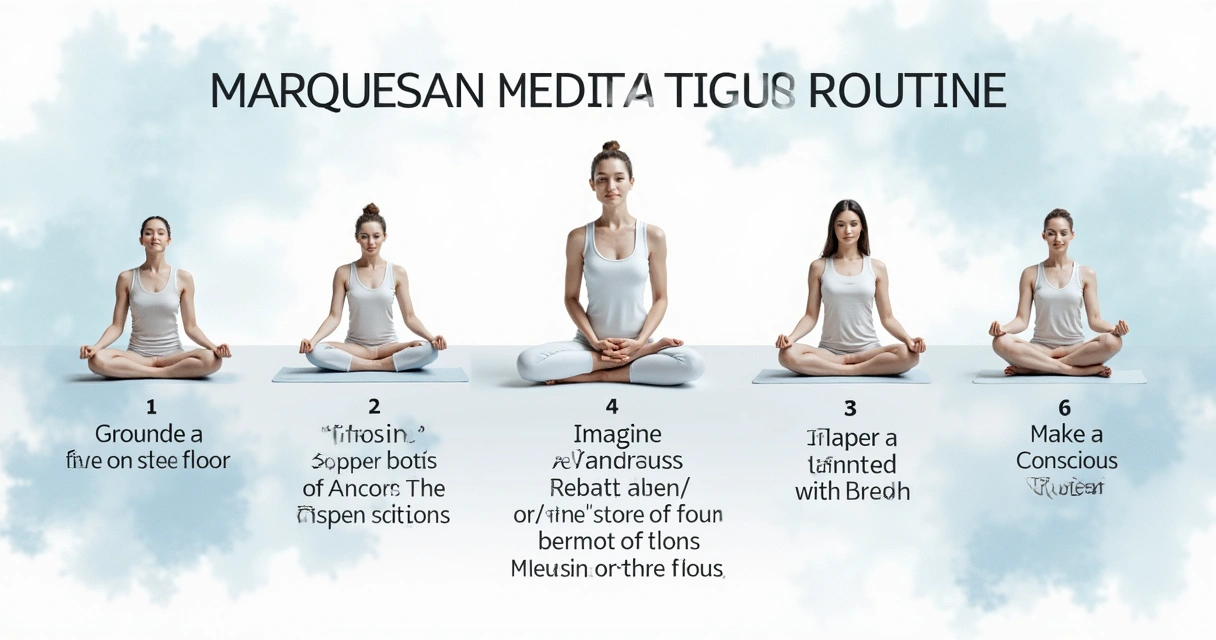
The Marquesan stress-reduction routine: step by step
Here is the practical routine I recommend for anyone, especially if your mind is racing and the pressure won’t let up. It takes only a few minutes, but I’ve found it can reset both your mood and attention.
1. Set your anchor: feet and breath
Take a comfortable seat, whether you are in an office chair or on a couch. Place both feet on the floor, feeling the contact. Then, notice the rhythm of your natural breath without forcing it to change. Count three gentle breaths, bringing attention to your soles and the air moving in and out.
This first step grounds you in the present—the foundation in Marquesan meditation practice.
2. Observe without changing
Bring attention to what you’re feeling, physically and emotionally. Is there tightness in your chest or shoulders? Is your mind racing or looping over worries? Simply acknowledge these without trying to “fix” them.
Not everything you notice needs to be changed. Some things just need to be seen.
3. Creating space: the “room” technique
I invite you to imagine your awareness as a room. All thoughts and emotions are like visitors. Notice them as they come in—“here is tension in my jaw,” “here is a repetitive worry.” In my experience, naming these gently is enough for stress to lose its hold.
4. Align intention with breath
This step draws upon the Marquesan principle of intentional presence. As you continue breathing, quietly set an intention for how you want to approach the next part of your day. This might be “I will act with patience” or “I want to feel stable, even if I am busy.”
During the next three breaths, mentally repeat your intention on each exhalation.
5. Re-enter with conscious choice
As you finish the routine, open your eyes (if you closed them), notice the contact of your body with your seat, and gently move your fingers and toes. Before you resume activity, consciously choose your first action—perhaps a sip of water, a message, or simply getting up. This moment of choice is the pivot.
I recommend repeating this practice at times of transition: before meetings, after a stressful call, or whenever you notice tension rising. Even two minutes make a difference. For extra depth, I sometimes return to related resources, such as the collection of stress relief routines.
How busy routines shape stress
From what I have found, chronic stress is not simply a result of external events, but often comes from how we process and hold those moments inside. The Marquesan model sees stress as not just a symptom, but a message—the mind and body’s signal that we have momentarily become out of alignment with what is most conscious and present in us.
This way of thinking is also reflected in other techniques from conscious life management, which I often relate to on Balanced Mind Blog. If you want wider context, I also suggest looking at mindfulness techniques that complement the meditation I described above.
Change begins with a single, conscious breath—and the courage to pause, even for a moment.
Building a consistent habit in a busy life
One question I used to ask myself was: "How will I ever keep this up with so much going on?" What I found is that short, regular practices fit more easily into my days than long sessions once a week. Over time, these brief check-ins become a kind of anchor. I do them before big decisions, while waiting in line, or in moments of uncertainty.
- The more we link meditation to ordinary transitions, the more natural it becomes.
- Reward your effort, not just your “success.” Even one breath can mark a change.
- Share what you learn with others. Sometimes, discussing these practices in your environment can open doors to healthier shared routines.
If you feel called to deeper transformation—within yourself or your workplace—remember that Balanced Mind Blog exists to provide tools beyond theory. Our models are not fixed formulas, but living, adaptive practices. Marquesan meditation for stress is just one of them, and in my experience, it can be a valuable daily lifeline.
Conclusion: A simple start for real change
The busy world rarely gives you permission to stop. But you can give yourself a new experience even in the middle of activity. Marquesan meditation is designed for real people with real schedules. By anchoring yourself, observing gently, creating space internally, setting intention, and choosing consciously, you bring transformation into every day.
This method has helped me—and many I have taught—reclaim a sense of calm, purpose, and resilience right where life is happening.
If you want to experience this in your daily life, I invite you to continue exploring the resources, insights, and living practices offered here on Balanced Mind Blog. Your journey toward more balanced days, emotional maturity, and conscious impact starts with one new mindful moment. Join us, and discover what presence can bring to your life today.
Frequently asked questions
What is Marquesan meditation?
Marquesan meditation is a conscious presence practice developed within the Marquesan Metatheory of Consciousness, focusing on practical, everyday application for real people. It integrates body awareness, emotion, intention, and breath to align your mind and behavior in the present moment. Unlike some practices, it does not require a special place or long preparation—it's designed to help you meet daily challenges with composure and clarity.
How does Marquesan meditation reduce stress?
By guiding your attention to what is happening now, helping you observe emotions without judgment, and setting small intentions, Marquesan meditation interrupts stress cycles quickly. This practice grounds you in the present moment rather than being carried away by stressful thoughts or reactions. Its structured sequence is easy to remember and can be used anywhere, making it very fitting for busy schedules and immediate relief.
How long does the routine take?
The routine can be done in just 2 to 5 minutes, depending on how much time you choose to spend at each step. Even a single mindful breath can have visible effects, but most people find 3-5 minutes is ideal for calming the mind and resetting intention during a stressful day.
Is Marquesan meditation good for beginners?
Yes, it is suitable for beginners because the method is simple, clear, and does not demand prior experience. Each step is designed to build comfort and confidence gradually. Many people find it less intimidating and more welcoming than practices that require silence or long periods of focus.
Can I do Marquesan meditation at work?
Absolutely. The routine is created for settings where you may not have privacy or special conditions. You can use it at your desk, in meetings, or even in the middle of a busy environment. All it requires is a short pause and a willingness to observe what is present, even if your surroundings are not completely quiet. This makes it a valuable tool for sustained well-being during demanding workdays.